A local delivery service lets an online brand get orders to nearby customers by car, often the same day, instead of sending every order through a parcel carrier. For brands with a store, warehouse or stockroom close to their customers, it can mean faster delivery, a more personal handoff and a reason to buy from you instead of a large marketplace. You can run it with your own drivers, hand it to a delivery partner, or combine the two.
This guide covers how local delivery works for online brands, the options for running it, how to price it and what to ask a delivery partner.

Why Online Brands Add a Local Delivery Service
Online shopping keeps growing as a share of retail. In its second-quarter 2026 report, the U.S. Census Bureau estimated U.S. retail e-commerce sales at $340.2 billion, or 17.1 percent of total retail sales. As more buying moves online, delivery speed and experience become part of the product.
Local delivery helps an online brand in a few ways:
- Speed. Same-day or next-day delivery to nearby customers without paying for expedited parcel shipping.
- A better handoff. A driver who carries the order to the door, takes a photo and can follow instructions.
- Products that do not ship well. Fragile, bulky, perishable or high-value items that are risky in a parcel network.
- Local loyalty. Customers who can get your product quickly have less reason to look elsewhere.
Ways to Run Local Delivery
- Your own drivers. Full control, but you carry wages, vehicles, insurance and scheduling. It works best with steady, dense order volume.
- A delivery service partner. Orders flow from your store to a partner who supplies the drivers. You pay per delivery and avoid building a fleet.
- A hybrid. Your own staff cover routine runs, and a partner covers peaks and areas you do not reach.
The trade-offs mirror the ones restaurants face. Our guide to outsourced delivery drivers breaks down the cost comparison in more detail.
Choose the Delivery Options You Will Offer
- Same-day delivery for orders placed before a cutoff time.
- Scheduled delivery, where the customer picks a day or time window.
- Routed delivery, grouping orders into planned routes on set days, which suits subscriptions and repeat orders.
- Recurring delivery for customers who reorder on a schedule.
Expedite’s e-commerce delivery page lists support for local same-day delivery, routed delivery, and pre-scheduled and recurring orders.
Set Your Delivery Zone and Pricing
Start small. Pick a zone around your store or warehouse where you have enough customers to keep delivery efficient, then expand once it runs smoothly. Common pricing models are:
- Flat fee inside the zone. Simple for customers to understand.
- Zone or distance pricing, with higher fees farther out.
- Free delivery over a minimum order, which can raise average order value.
Base the fee on your real cost per delivery, including the share of orders that need a second attempt or support, and check your margin on the smallest orders you will deliver.
Add Local Delivery to Your Checkout
The customer should see local delivery only when their address qualifies, with a clear price and delivery window. Behind the scenes, the order needs to reach whoever is driving without someone retyping it. Ask any provider how orders get from your store platform or order management system to their drivers.
Expedite says it lets e-commerce businesses add local delivery to the checkout process “without changing your existing operations.” Its retail delivery page adds POS and order management system integrations, and delivery from stores, warehouses or microhubs.
Tracking, Proof of Delivery and Support
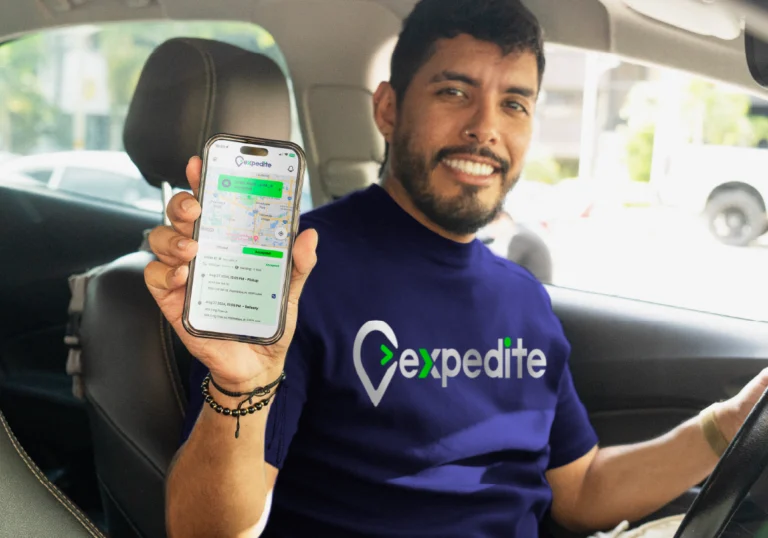
Customers who order online expect to know where their order is. A good local delivery service should give you:
- Live tracking from dispatch to delivery.
- Branded tracking links and notifications, so the experience still feels like your brand.
- Photo proof of delivery.
- A support team that handles exceptions, such as a customer who is not home.
Expedite’s e-commerce page lists live delivery updates, branded tracking links and access to real-time support from its customer service team. Its retail page says proactive updates and complete visibility help reduce “Where is my order?” calls. If keeping your brand on the delivery experience is a priority, our post on white label delivery explains how it works.
Questions to Ask a Local Delivery Partner
- Which areas and markets do you cover?
- How are drivers matched to my orders, especially fragile or bulky items?
- Which delivery options do you support: same-day, scheduled, routed, recurring?
- How do orders get from my store platform to your drivers?
- What tracking and proof of delivery will my customers see?
- Who handles failed deliveries and customer questions?
On driver matching, Expedite says it matches orders with qualified, independent drivers “based on vehicle type, experience, and brand alignment,” and it delivers in more than 200 markets nationwide. For the bigger picture on the final leg of an order, read our guide to last mile delivery service.
Key Takeaways
- A local delivery service gets online orders to nearby customers by car, often the same day.
- You can use your own drivers, a delivery partner or a mix of both.
- Start with a small zone and price from your real cost per delivery.
- Customers expect live tracking, branded updates and photo proof of delivery.
- Ask partners how orders reach their drivers and how drivers are matched to your products.
Frequently Asked Questions
What is a local delivery service?
A local delivery service carries orders from a store, warehouse or kitchen to customers in the same area, usually by car and often the same day or on a scheduled day. It is different from parcel shipping, which moves packages through carrier networks over longer distances.
How do I offer local delivery for my online store?
Define a delivery zone, choose who will drive (your own staff, a delivery partner or a mix), set your pricing and delivery windows, add the option to your checkout, and set up tracking and notifications for customers. Start with a small zone and expand once it runs smoothly.
How much should I charge for local delivery?
Common approaches are a flat fee within the zone, fees by distance or zone, or free delivery above an order minimum. Set the price from your actual cost per delivery and your margins, then test what customers accept.
Is local delivery better than shipping for small businesses?
For nearby customers it can be faster, and it avoids packaging for parcel networks. Shipping still makes sense for customers outside your area. Many online brands offer both and let the customer’s address decide which options appear at checkout.
Do I need my own drivers to offer local delivery?
No. You can use a delivery partner instead of building a fleet. Expedite’s retail page says it helps retailers offer local delivery without the need to build or manage an in-house fleet, and its e-commerce page says local delivery can be added to your checkout without changing your existing operations.
If you want to add local delivery to your online store, schedule a demo with Expedite today.